
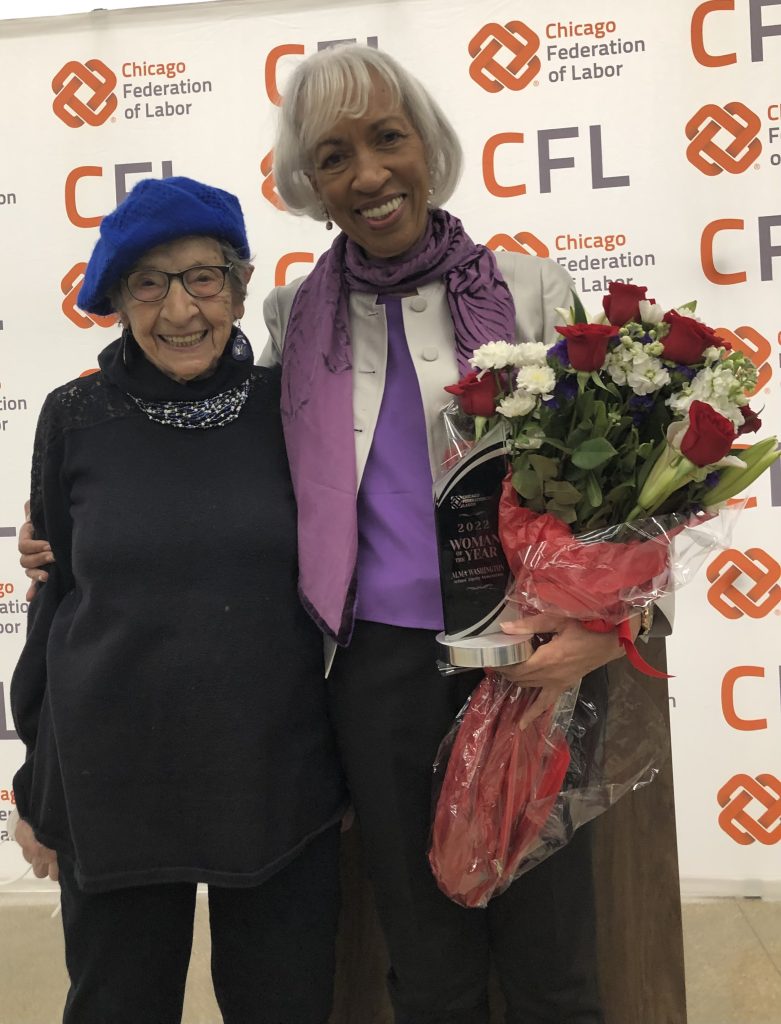
Eleanor Roosevelt said “Courage is more exhilarating than fear.” I know of no one who had more courage than Bea Lumpkin. An early advocate for labor, she was a teenager when she raised her voice to support textile workers in Passaic, NJ. At Hunter College, the school threatened to raise the price of milk to 6 cents. As a member of the Young Communist League, Bea organized a boycott to keep the price at 5 cents a half pint. She was active in many of the labor struggles in New York and across the country. She was arrested the first time for peddling the “Daily Worker” newspaper in front of the Public Library. In 1937, at the age of 20, the CIO hired her to help organize more than 30,000 workers in the Laundry Workers Industrial Union.
In later years, Bea published books and essays on the multicultural roots of mathematics. As a teacher, she spent a month in South Africa teaching students mathematics. Her life experiences as a civil rights and labor activist prepared her for a career in teaching at Malcolm X College. She and her students demanded African American Studies, Latino Studies, and Women’s Studies. Her belief was that women’s rights and civil rights can best advance when labor’s rights advance.
Bea and her husband Frank fought a battle to hold Wisconsin Steel accountable to pay its former workers their pension and won. Always fighting for labor, she often said “No matter how big the company is, we workers are stronger when we are united.”
Years ago, I was invited to speak about Lucy Parsons, widow of the Haymarket
Martyr Albert Parsons, at a Communist Convention held in Philadelphia, PA.
After the session was over, a woman said to me “I like what you talked about, but it was too long.” That was my first introduction to Bea Lumpkin. After that, she invited me to the Illinois Labor History Society’s Union Hall of Honor event. We got to know each other, and I started volunteering at the ILHS office, became a member, and later was elected to the Board of Trustees. One of the
organizations we both enjoyed working with was the Coalition Of Labor Women (CLUW), of which Katie Jordan was Chicago local chapter president. Bea was there in 1974 when CLUW was founded. They invited me to lunch and announced that I was to be given the Olga Marie Madar Award at the next CLUW Annual Dinner. I considered Bea and Katie as mentors in this large labor movement, and was honored to be even considered. Bea was present when the CFL in 2022 named me the Labor Woman of the Year. When she helped to found INTERGEN, a coalition of retirees and young activists from the labor movement, I was there to support her. Her life was devoted to activism, and I’m trying to follow her lead.
We, as friends, often forget how small things and simple pleasures can mean so much to each other. After one of the CFL meetings, Debby Pope was giving
Bea and me a ride home. When we arrived at the apartment building where Bea lived in Hyde Park, she said “I’d like to show you something, but I guess it’s too late and you want to get going.” We said “no, anything for you Bea.” When we got up to her apartment she said, “just look at that view.” It was beautiful; looking out over the lake, the Chicago skyline never looked more breathtaking. Bea was happy and proud to show it, and Debby and I were pleased we took the time.
Over the years Bea would take the bus from Hyde Park and we’d meet for lunch in the Walnut Room of Field’s, before Macy’s took over. We enjoyed chats on the phone. When I’d call, she’d always say “ALMA!” and I’d say “yes, Bea, it’s me,” and we’d laugh; it was sort of a ritual. For her 103rd birthday, her son and daughter in-law gave her a party. Bucky Halker played great music and Bea danced, and while she was dancing I thought “oh gosh, I hope she doesn’t fall”…she loved to dance. When she moved to Montgomery Place, I’d go over for lunch or dinner twice a month if possible. Sometimes just sit in an area off the lobby, have tea and chat about her life.
Bea was indeed our warrior for labor, unions and workers. She was a direct and kind mentor. My loyal and devoted friend.
On my last visit to Montgomery
Place, there had been several visitors before me and the caregiver wanted her to rest. Bea asked me not to go—she had never said that before. I said ‘I’ll be back.” When I got to the door, she smiled and blew me a kiss. I did the same to her. I had that sad uneasy feeling that this might be my last visit, and it was. To ease my sadness, I think how fortunate I am to have known her.
Farewell Dear Bea.