
For anyone who knew Bea Lumpkin or knew of her, it was hardly a surprise that the hall was packed. Folding chairs were needed in addition to the array of round tables. Bea, who died at 107 years of age, led a life fighting for social justice in many venues, and her companions and comrades from those fights were there to celebrate her life. They included politicians, labor leaders, relatives, and friends, all of whom had participated in social justice movements and who had admired Bea’s consistent and unrelenting work to the end of her life. Musicians Bucky Halker and Justina Medina offered labor songs in English and Yiddish. Bucky opened the event with “Rebel Girl” by Joe Hill. While Justina sang a Yiddish song “Arbeter Froyen” or “Working Women,” a solitary male voice sitting near me sang along in Yiddish. For other songs, printed lyrics enabled us all to participate.
John and Paul Lumpkin, Bea’s and Frank’s two sons, welcomed us, recounted some of Bea’s early life, and emceed the celebration. Stacy Davis Gates, President of the Chicago Teachers Union and the Illinois Federation of Teachers, welcomed attendees to the Chicago Teachers Union Hall, and Chicago Mayor Brandon Johnson spoke of his admiration for Bea’s work. He quipped that his administration was one of two that Bea could get along with. Because she was unable to attend, U.S. Representative Jan Schakowsky, 9th District, Illinois, had her tribute read by Ed Sadlowski, Jr., Deputy Director at Milwaukee Teachers’ Education Association, and U.S. Representative Jesus ‘Chuy’ Garcia, 4th District, Illinois, gave his remarks in person, citing his and Bea’s joint support for the murdered Latino labor activist Rudy Lozano.
Bea’s organizing work began when she was still a teenager in New York City. It continued in Buffalo, New York, and then in Chicago. Bea did not seek leadership positions in the organizations she worked with, but she was unrelenting in her commitment. When she married Frank Lumpkin, they organized together and then together fought Wisconsin Steel, where Frank had worked. The company simply closed its doors one day, locking out the workers, denying them any past pay or future pensions. It took 17 years of legal fights to get some compensation for those workers. Two female labor leaders, Liz Shuler, President AFL-CIO, and Roxanne Brown, International President United Steelworkers, sent recorded speeches in which they both thanked Bea for laying the groundwork for women to lead. Although Bea herself never sought elected leadership positions, they agreed that she represented “power, passion, fight, and love,” and they were deeply grateful for her life’s work.
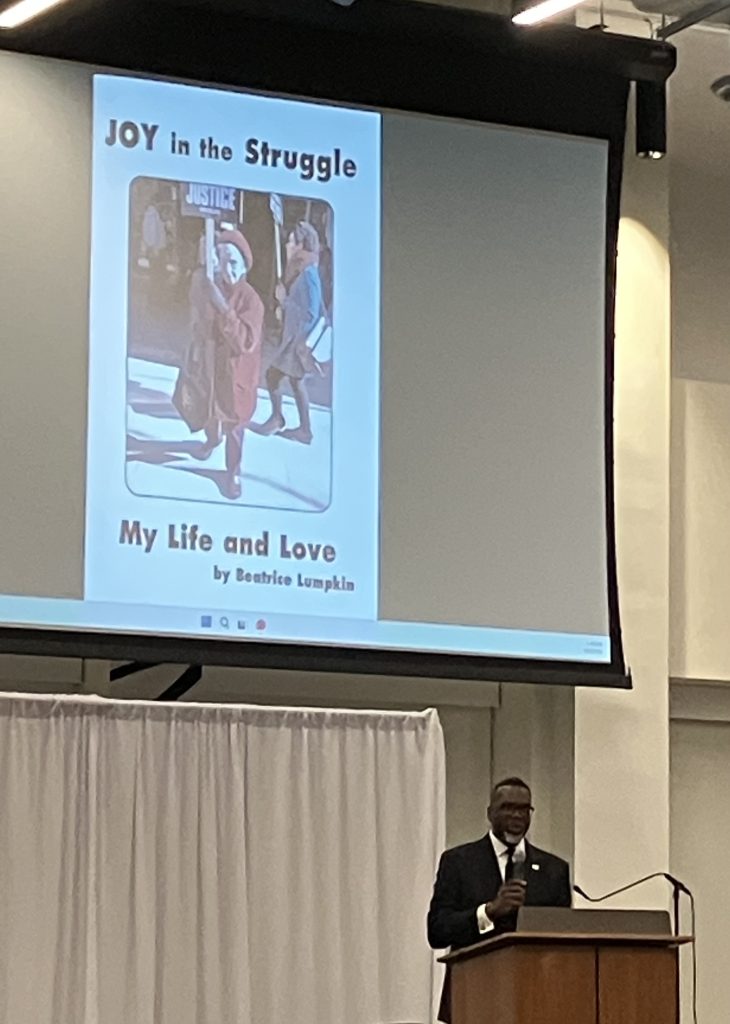
Bea documented her and Frank’s life in Always Bring a Crowd and her own story in Joy in the Struggle. She later authored books about African contributions to the study of mathematics, which she wrote while teaching math at Malcolm X College. The memorial included a 17-page booklet filled with photos, a long piece on Bea’s history, and tributes from the Congressional Record, the Board of Commissioners of Cook County, and a 2018 letter from Barack Obama, President of the United States. Throughout the memorial, the screens above the speaker’s platform displayed photos of Bea in all the phases of her life along with her compatriots and photos of her publications. The prevailing emotion was one of joy and accomplishment.
In her remembrance, Roberta Wood, a lifelong comrade in the Communist Party and friend of Bea’s, captured the essence of Bea when she ended her remarks with the observation that a moment of silence hardly seemed appropriate for Bea Lumpkin. The audience guffawed. Instead, she asked us all to stand and together to chant “We’re Loud! We’re Proud! We always bring a crowd!” With enthusiasm and joy, we did just that. Bea’s energy, enthusiasm, passion, and joy will remain with the memorial participants.